
Why More Followers Do Not Lead to More Sales
Jun
Why More Followers Still Don’t Mean More Sales
Many brands celebrate when follower counts rise. It feels like progress, proof that the content is working, and validation that the brand is gaining attention. But in many cases, a larger audience does not translate into higher revenue.
This is one of the most common frustrations in social media marketing: the followers are growing, but sales are not.
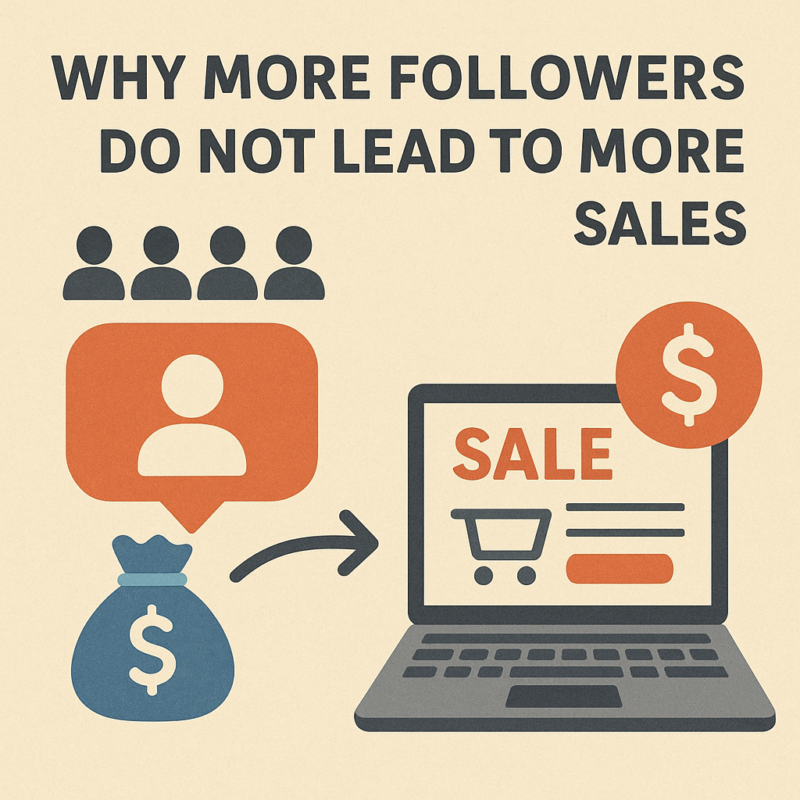
The reason is simple. Followers are not the same as buyers. A large audience may look impressive on the surface, but unless that audience is qualified, engaged, and guided through the right buying journey, it will not create meaningful sales outcomes.
1. Follower Growth Does Not Guarantee Buyer Intent
A social media follower may be interested in your content, your visuals, or your personality. But interest alone does not mean purchase intent.
People follow brands for many reasons:
- Entertainment
- Inspiration
- Industry updates
- Discounts
- Curiosity
- Social proof
Only a small portion of followers are actively ready to buy at any given time. If your content attracts broad attention but does not filter for specific customer needs, follower growth can become disconnected from revenue growth.
2. The Audience May Be Too Broad
One of the most common reasons sales remain flat is that the content is reaching the wrong audience.
A large follower base can include:
- Non-buyers
- Competitors
- Casual browsers
- Giveaway seekers
- Users outside your target market
When your messaging is too general, it may outperform in reach but underperform in conversion. Broad content can increase vanity metrics without improving commercial performance.
To drive sales, your audience must not only be large, but relevant.
3. Content May Be Designed for Attention, Not Conversion
High-engagement content is often optimized for likes, shares, and comments. That is useful, but it is not enough.
Content that gets attention does not always move people toward a purchase. In many cases, brands publish posts that are:
- Highly entertaining
- Visually strong
- Trend-driven
- Easy to consume
But they fail to answer the questions buyers actually ask:
- What problem does this solve?
- Why is this better than alternatives?
- Why should I trust this brand?
- What should I do next?
Without a clear conversion path, even strong content can stop at engagement.
4. There Is No Clear Funnel
Sales rarely happen from a single post. They happen through a process.
If a brand does not have a clear funnel, followers may enjoy the content but never progress toward purchase. A strong social media funnel usually includes:
- Awareness content
- Consideration content
- Trust-building content
- Decision-stage content
When all content sits at the awareness stage, the audience is entertained but not guided. That creates visibility without measurable sales impact.
5. Trust Has Not Been Built Strongly Enough
People do not buy simply because they know a brand exists. They buy when they trust that brand.
Follower growth can create visibility, but trust requires more than reach. Buyers want to see:
- Consistency
- Credibility
- Social proof
- Product value
- Transparency
If your brand has attention but lacks trust signals, potential customers may hesitate. They may follow, watch, and wait — but never convert.
6. The Offer Is Not Clear or Compelling
Sometimes the problem is not the audience or the content. It is the offer.
Even with strong follower growth, sales will remain weak if the offer is not compelling enough. Common issues include:
- Unclear value proposition
- Weak differentiation
- Pricing mismatch
- Poor timing
- Low perceived urgency
A user may like your content and still not see a strong enough reason to purchase. In that case, growth in followers becomes a traffic metric, not a revenue metric.
7. The Platform Strategy Is Misaligned with the Business Goal
Not every platform performs the same role in the customer journey. Some platforms are better for discovery, while others are stronger for conversion support.
If a business expects direct sales from a platform that mainly generates awareness, the performance will feel disappointing. The issue may not be the platform itself, but the expectation placed on it.
A more effective strategy aligns content, platform behavior, and business objective.
8. Vanity Metrics Are Being Mistaken for Performance
Follower count, likes, and views are easy to track, but they do not always reflect business success.
A brand can grow rapidly in visibility while still failing to:
- generate qualified leads
- build a returning customer base
- increase average order value
- improve conversion rate
That is why revenue-focused marketing requires looking beyond surface-level metrics. If the business goal is sales, the core question is not “How many people followed?” but “How many of them bought?”
How to Fix the Gap Between Followers and Sales
To turn followers into customers, brands need to shift from audience growth to audience quality and conversion.
That means:
- Targeting the right market
- Creating content for different funnel stages
- Strengthening trust signals
- Clarifying the offer
- Tracking sales-related metrics, not just engagement
When a brand understands the difference between attention and conversion, social media becomes a more reliable business channel.
Final Thought
More followers do not automatically create more sales. They only create opportunity.
Revenue comes from the right audience, the right message, the right offer, and the right customer journey. Without those elements, follower growth remains a surface-level win rather than a business result.
If sales are not increasing, the issue is rarely just the number of followers. More often, it is the gap between visibility and conversion.
If you'd like, I can also turn this into:
- a more premium business-blog style,
- a more short-form SEO article, or
- a Korean-to-English natural translated version with a stronger marketing tone.
Instagram bestsellers!

 Instagram
 Facebook
 Tiktok
 Youtube
 X (Twitter)
Instagram Comments – Thailand