
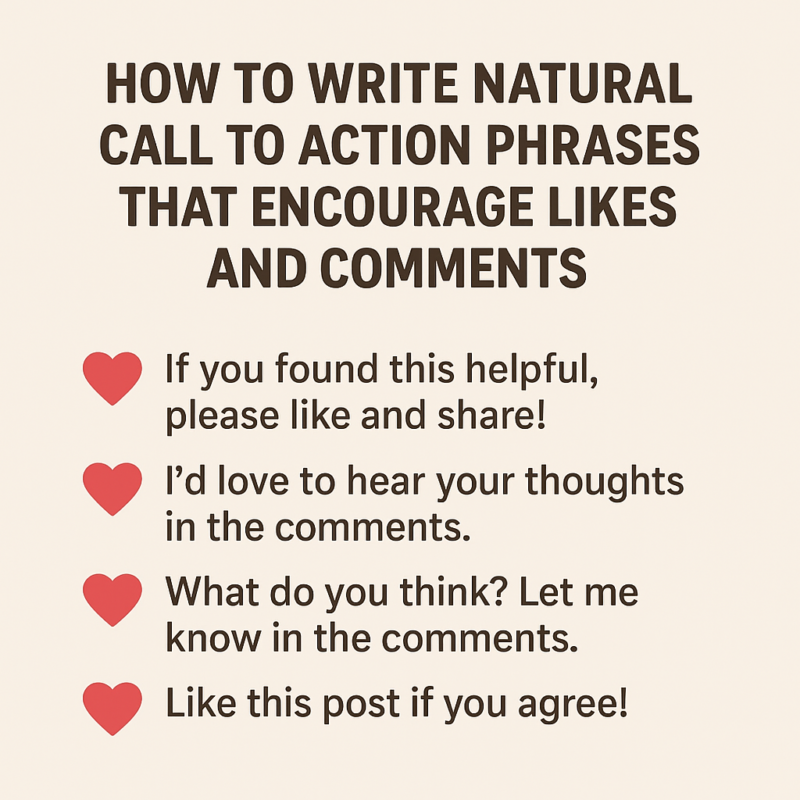
How to Write Natural Call to Action Phrases That Encourage Likes and Comments
Jul
How to Write Natural Phrases That Encourage Likes and Comments
If you create content online, you already know that engagement matters. Likes and comments are not just vanity metrics—they help your post reach more people, build trust, and create a stronger connection with your audience. The challenge is doing this without sounding forced, promotional, or overly salesy.
The good news is that you can encourage interaction in a way that feels natural, professional, and authentic. The key is to invite participation rather than demand it.
Why Natural Engagement Phrases Work
People respond better to content that feels conversational. When a post sounds too direct, too repetitive, or too needy, readers often ignore it. But when you use simple, relevant, and human language, engagement feels like a natural next step.
A well-written engagement line can:
- make readers pause and reflect
- create a sense of community
- increase the chance of a comment or like
- improve visibility on social platforms
Principles for Writing Natural Like and Comment Prompts
1. Keep the tone conversational
Write as if you are speaking to a real person, not broadcasting to a crowd. Short, clear phrases tend to work best.
Examples:
- What do you think?
- Have you experienced this before?
- I’d be interested to hear your perspective.
- Does this match what you’ve seen?
These phrases feel open and respectful, which makes people more comfortable responding.
2. Make the prompt relevant to the content
The best engagement phrase is tied directly to the topic of the post. Generic lines like “Leave a comment below” can feel disconnected. Instead, reference the idea, question, or situation you just discussed.
Example:
If your post is about productivity, you might say:
- Which strategy works best for you?
- Do you prefer planning ahead or working spontaneously?
This makes the comment feel meaningful rather than routine.
3. Use gentle invitations instead of commands
Asking for engagement is more effective than telling people what to do. Soft language reduces pressure and feels more natural.
Better phrasing:
- I’d love to know your thoughts.
- Feel free to share your experience.
- Let me know if you agree.
- If this was helpful, a like is always appreciated.
These lines are polite, subtle, and easy to accept.
4. Focus on value first
People are more likely to engage when they feel the content gave them something useful, interesting, or relatable. A strong post should stand on its own before asking for interaction.
For example:
- After sharing a tip, ask what method others use.
- After presenting a perspective, ask whether readers see it differently.
- After telling a story, ask if they’ve had a similar experience.
This creates a smooth transition from content to conversation.
Natural Phrases for Likes
If you want to encourage likes without sounding pushy, keep the wording light and appreciative.
Examples:
- If you found this useful, a like is appreciated.
- A like helps support more content like this.
- Glad this was helpful.
- Thanks for reading.
These phrases work because they acknowledge the reader without pressure.
Natural Phrases for Comments
Comment prompts should encourage reflection or personal response. The more specific the question, the better.
Examples:
- How would you approach this?
- What’s your take on this?
- Have you seen a similar result?
- What has worked for you in this situation?
- Do you agree with this approach?
These questions are open-ended and simple enough to invite genuine replies.
Best Practices for SEO and Engagement
If you are writing blog content, SEO matters too. Natural engagement phrases should not interrupt the flow or feel like keyword stuffing. Instead, place them where they make sense in the article, often near the end of a section or conclusion.
To improve SEO and readability:
- use clear headings
- include the primary keyword naturally
- write short, scannable paragraphs
- avoid repetitive calls to action
- match the tone to your audience
For example, if your keyword is natural engagement phrases, use it in the title, one or two subheadings, and once or twice in the body—never excessively.
Final Thoughts
Writing effective engagement prompts is not about forcing interaction. It is about creating a space where readers feel comfortable responding. The best phrases are simple, relevant, and human.
When you invite rather than pressure, engagement becomes more authentic—and often more effective.
If you want, I can also turn this into:
- a more SEO-rich blog version,
- a short-form social media version, or
- a Korean-to-English polished article style.
Instagram bestsellers!

 Instagram
 Facebook
 Tiktok
 Youtube
 X (Twitter)
Instagram Comments – Thailand